
 (720) 386-5650
Getting It Right the First Time: A Commercial Deadbolt Installation on a Denver Metal Door
Most deadbolt installs look simple from the outside. The hardware goes in, a couple of screws get tightened, and the job looks done. But the difference between a deadbolt that holds under pressure and one that fails the first time someone leans on the door hard enough comes down entirely to what happened during this commercial deadbolt installation in Denver. Before the first screw touched the door.
This post walks through a recent commercial deadbolt installation on a metal door in Denver. Including the specific techniques our technician used to ensure precise placement and a reinforced, lasting result. If you manage a commercial property, run a multi-unit building, or are upgrading security on a metal door that has seen better days, this is what proper installation actually looks like.
What This Job Involved
The call was a fresh deadbolt installation on a commercial metal door. A common request for offices, back-of-house doors in hospitality properties, and utility or storage access points in multi-tenant buildings. The door already had a lever handle lockset in place. The customer needed a deadbolt added above it for an additional layer of security.
What makes a commercial metal door different from a standard lock installation is the door material itself. Steel and hollow-metal doors don’t forgive imprecise hole placement the way a wood door does. Drill a hole in the wrong spot on a wood door and you have options. On a metal door, that hole is permanent. Getting the position right before any drilling starts is not optional – it’s the whole job.
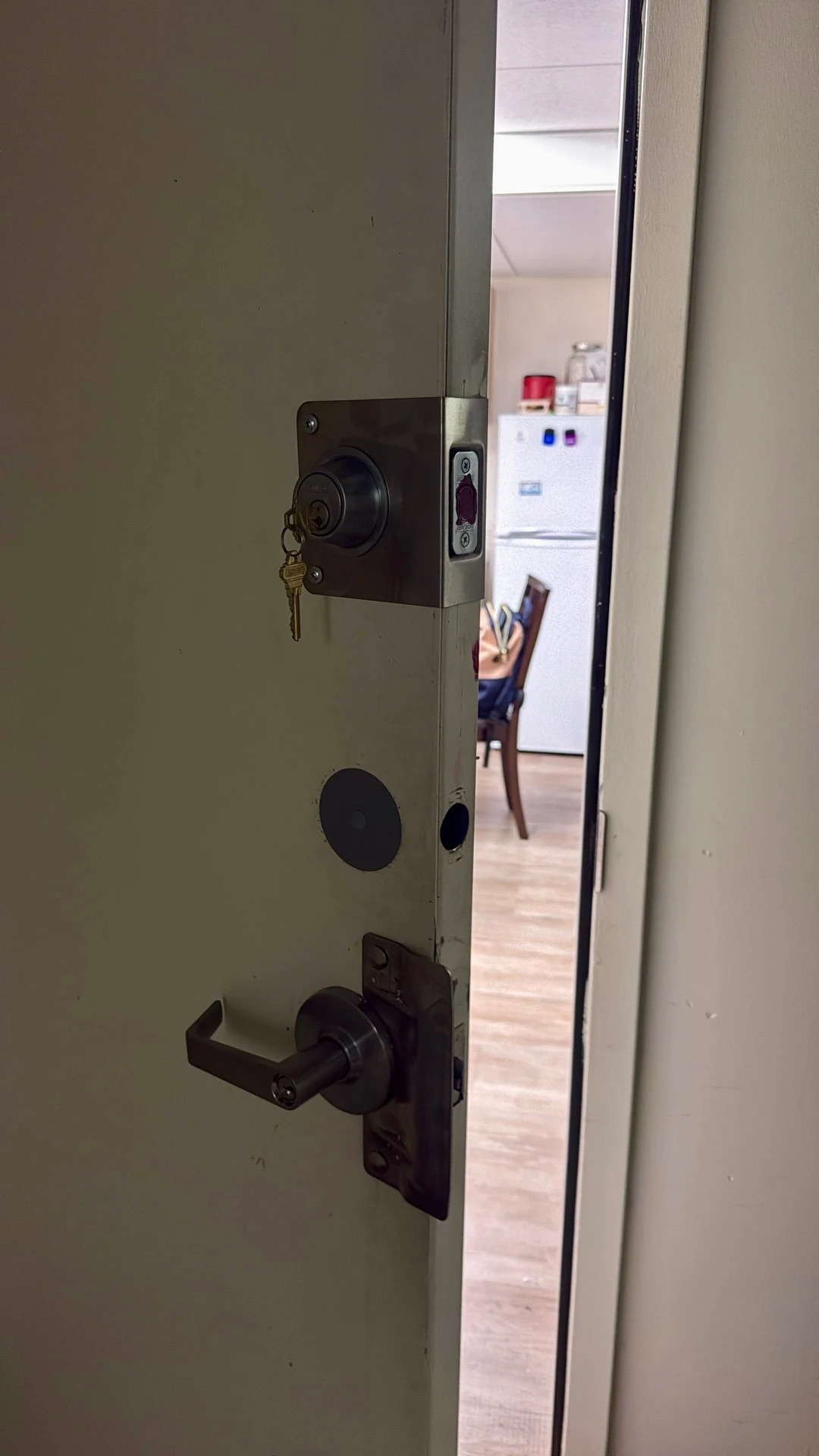
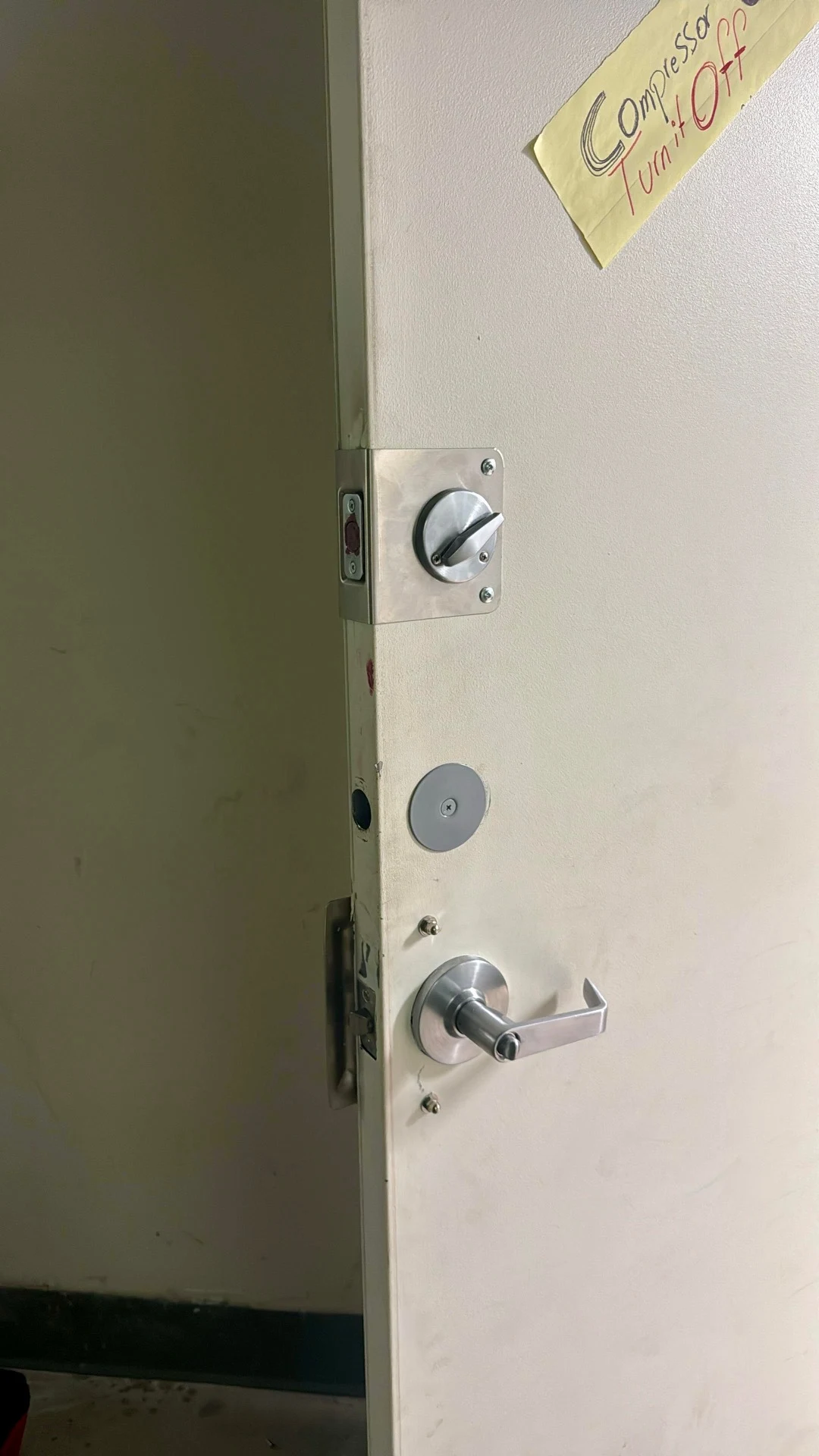
The completed installation included a new deadbolt with a thumbturn on the interior side. A matching lever handle lockset, and a wrap-around reinforcement plate on the door edge. Here’s how each part of the process went.
The Lip Gloss Transfer Technique: Why Professionals Use It
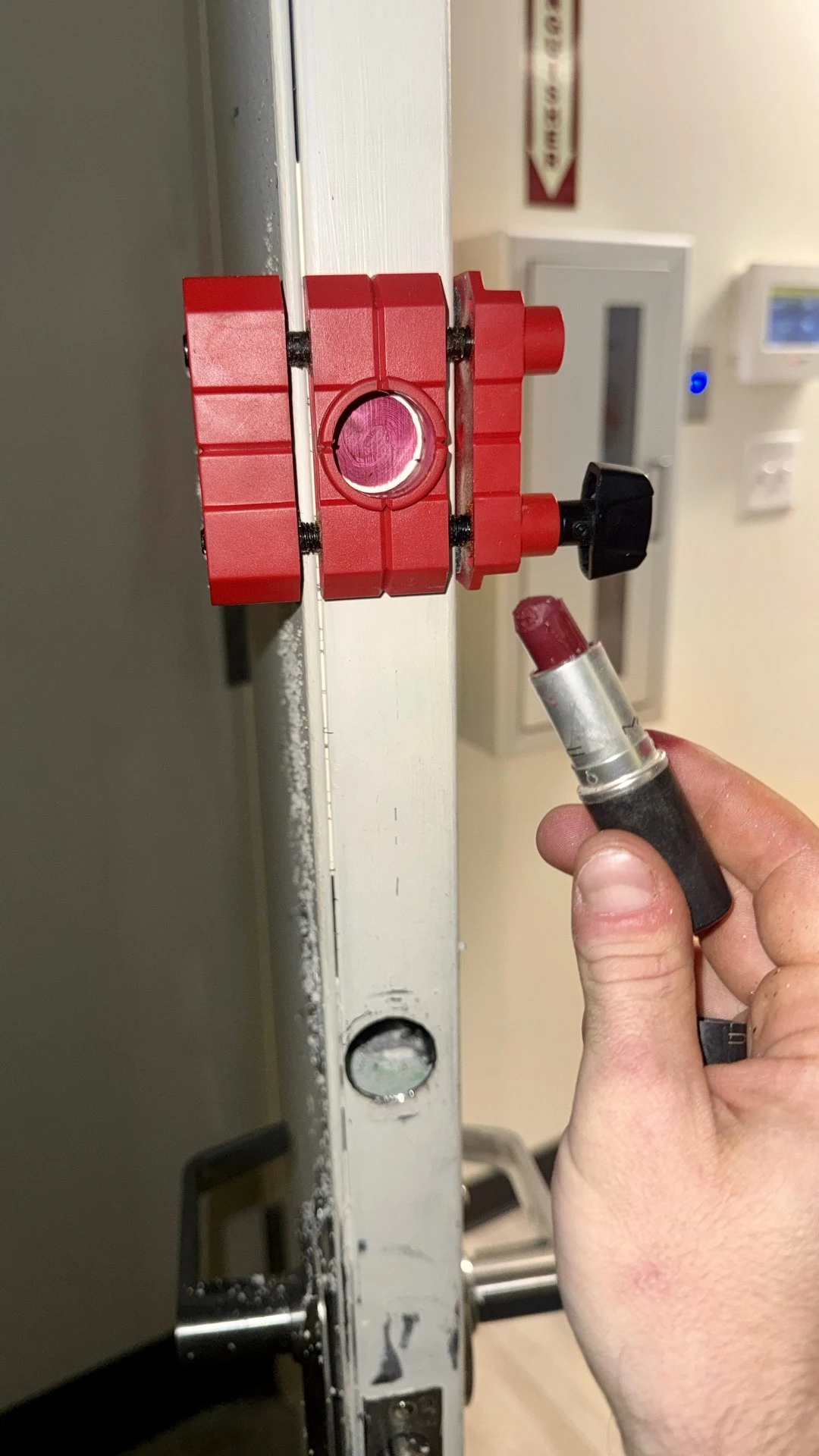
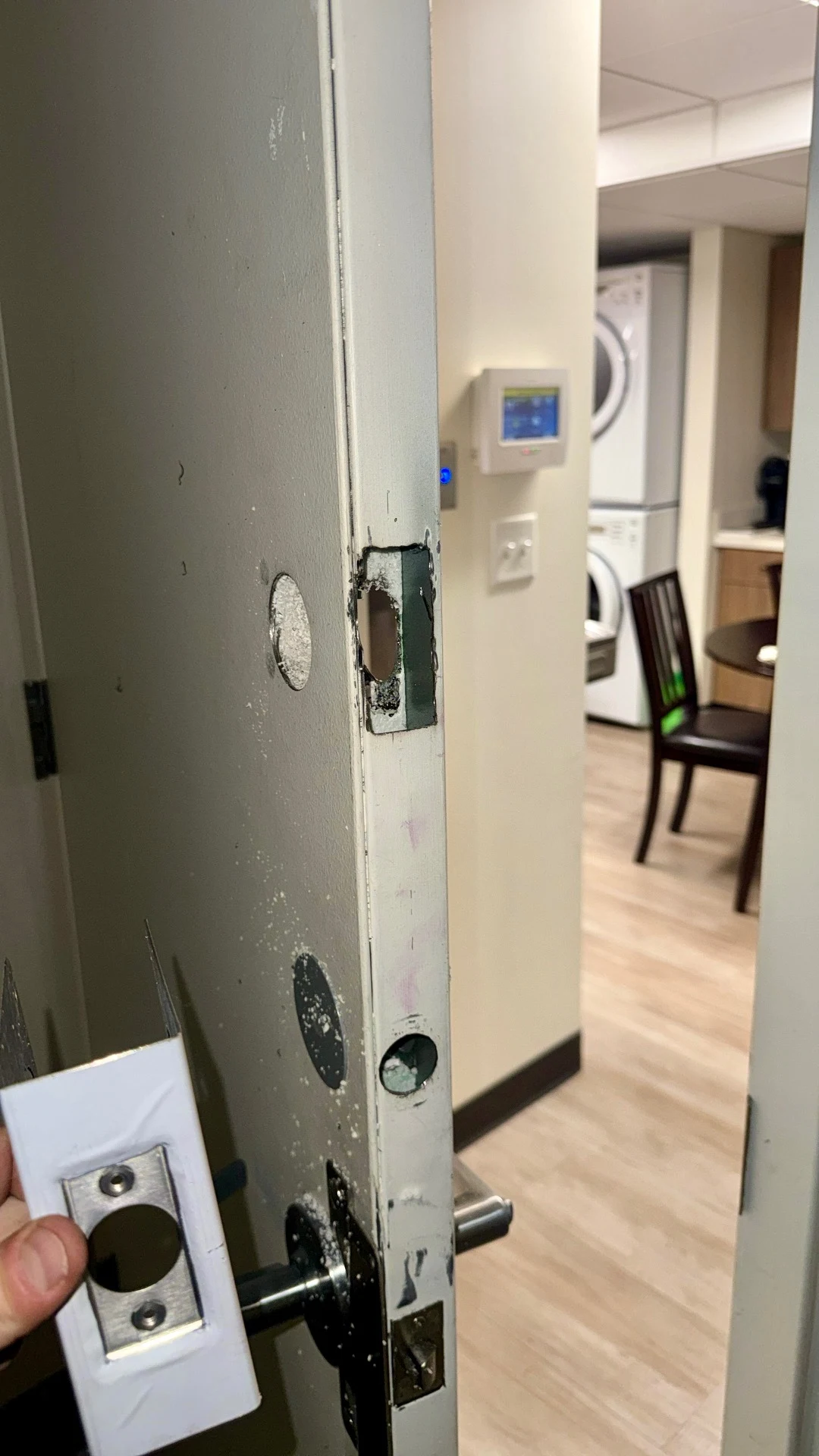
One of the more visually memorable parts of this job was the marking method used to locate the strike position on the door frame with complete accuracy. The technique involves applying lip gloss or lipstick to the deadbolt’s latch face. Then, closing the door slowly against the frame, and reading the transfer mark left on the frame surface. That mark shows exactly where the bolt contacts the frame. Which is precisely where the strike plate hole needs to be cut.
It sounds low-tech because it is. It also works better than any measuring approach for one straightforward reason: it accounts for real-world variables. Door frames are not always perfectly square. Doors are not always hung at exactly the specified tolerances. A measurement taken from a reference point on the door may not translate cleanly to the frame if either surface is slightly out of plumb. The transfer method bypasses all of that by using the door’s actual movement to identify the true contact point.
Seasoned locksmiths and carpenters have used variations of this technique for decades. On a commercial metal door where the strike has to be mortised or cut into a reinforced frame, starting with an exact mark prevents the kind of off-center installation. This causes a deadbolt to drag, bind, or fail to engage cleanly under real-world use.
Precision Drilling: Why a Jig Matters on Metal Doors
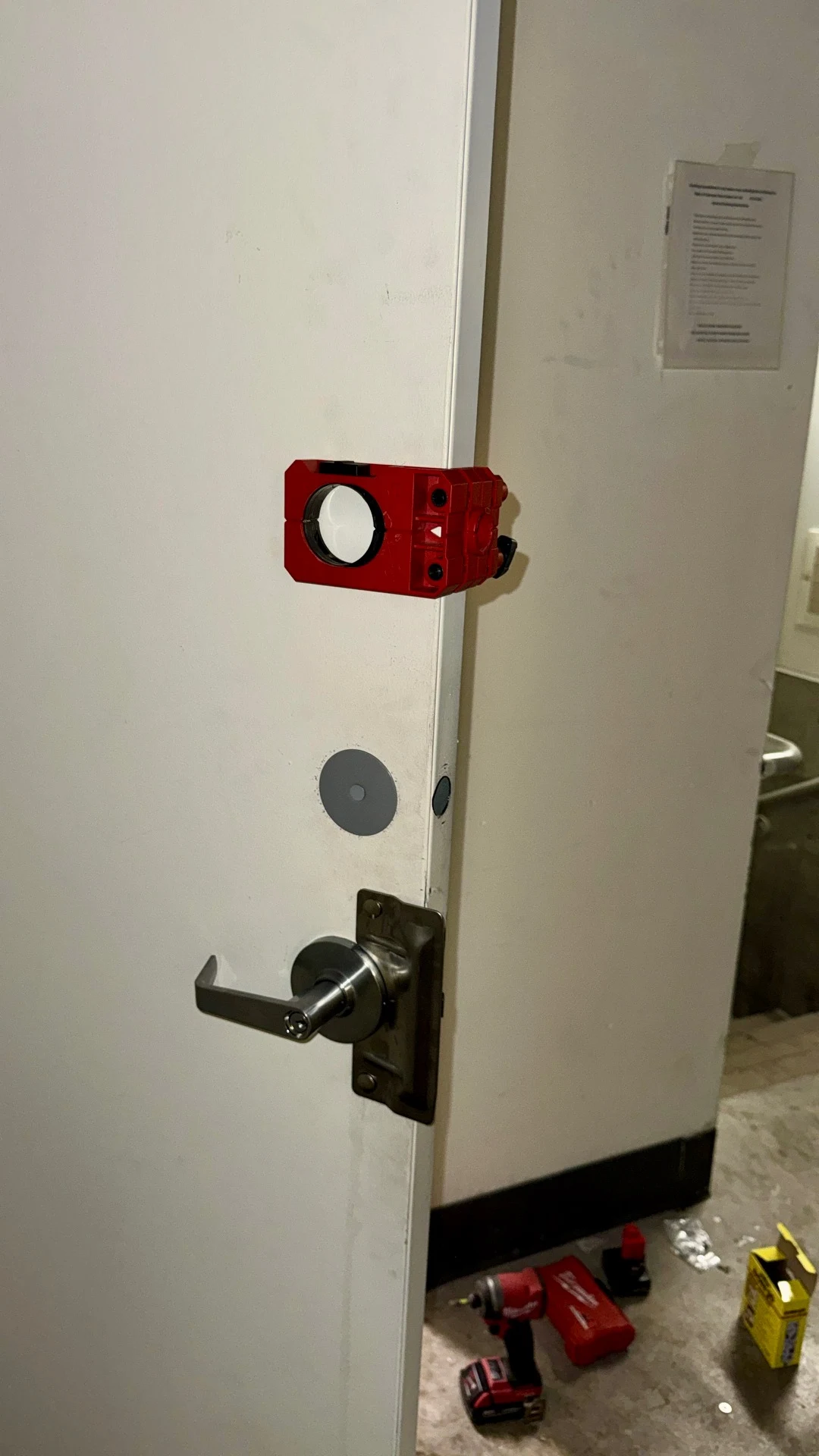
After the transfer mark confirms the strike location, the next step is cutting the cylinder hole in the door itself with equal precision. For this installation, our technician used a professional door lock installation jig – the red tool visible in the process photos. A jig clamps to the door edge and guides the drill bit at exactly the right angle and depth so the cylinder hole, the latch bore, and the cross-bore all align correctly relative to each other and to the door edge. This is standard procedure for a professional commercial door lock service.
On a metal door, this matters more than most installers acknowledge. Wood can be patched, shimmed, or filled if a bore is slightly off. Metal cannot. A cylinder hole that’s even a few millimeters off-center results in a deadbolt that binds against the door edge when throwing the bolt, a misaligned strike engagement that wears the bolt tip prematurely, or a latch that won’t sit flush. None of those outcomes are acceptable on a commercial door that needs to operate reliably hundreds of times a week.
Using the jig also ensures consistent depth. The cylinder needs to sit at the correct depth relative to the door face so the rose plate sits flush and the thumb turn clears any adjacent hardware. On a door that already has a lever set below the deadbolt, that clearance check matters on both sides during installation.
The Wrap-Around Reinforcement Plate: What It Does and Why It’s Not Optional
The detail that separates a professional commercial deadbolt installation from an adequate one is the wrap-around door reinforcement plate. This component is a formed steel plate that wraps around the door edge, covering the latch and deadbolt bore area on the face, edge, and interior side of the door simultaneously. It’s secured with screws that go through the door skin and into the door structure rather than just the surface, which is what gives it its holding strength. For any door where security is the actual goal – not just the appearance of security – this reinforcement is part of the install, not an optional add-on. You can see the completed result in our commercial locksmith gallery.
What the Wrap-Around Plate Protects Against
Standard deadbolt installations on commercial metal doors use a single-sided faceplate on the door edge. That plate covers the bolt mechanism and provides a mounting surface, but it does not reinforce the door against forced entry at the latch point. The most common forced-entry technique on commercial doors is not picking the lock – it’s applying lateral force to the door at the latch area, which splits the door skin away from the latch hardware or pries the faceplate out of the door edge entirely. A standard faceplate provides minimal resistance to this.
The wrap-around plate changes this significantly. Because the plate contacts three surfaces of the door and is secured with multiple anchor points, a prying attack on the latch area has to overcome the full plate assembly rather than just the edge faceplate. The door skin itself becomes part of the reinforcement system. For commercial properties, back-of-house entries, utility doors, and any door that secures a space with real value behind it, this is the correct hardware configuration.
Wrap-Around vs. Standard Faceplate: A Comparison
| Factor | Standard Edge Faceplate | Wrap-Around Reinforcement Plate |
|---|---|---|
| Coverage area | Door edge face only | Door edge, exterior face, and interior face |
| Anchor points | Two screws into door edge | Multiple screws through door skin and edge |
| Forced entry resistance | Moderate – edge faceplate can be pried | Significantly higher – three-surface grip resists prying |
| Finish | Narrow strip visible on door edge | Clean plates visible on door faces and edge |
| Recommended for | Interior doors, lower-security applications | Commercial entries, exterior doors, high-security installs |
| Installation complexity | Standard | Requires precise alignment across all three surfaces |
Choosing the Right Deadbolt Hardware for a Commercial Metal Door
Not every deadbolt is built for commercial use. Residential-grade deadbolts are designed for lighter doors and lower cycle counts. They work fine in a home where a door might be opened 20 or 30 times a day. On a commercial door that may see several hundred operations daily, residential hardware wears out faster, and the lower-grade cylinder construction offers less resistance to manipulation. A proper commercial deadbolt installation starts with hardware rated for commercial use.
Commercial-grade deadbolts are built to ANSI/BHMA Grade 1 standards, the highest rating for lock hardware. Grade 1 hardware is tested to 250,000 operating cycles minimum, uses heavier bolt construction, and is built with tighter tolerances throughout the cylinder and mechanism. For a metal door on a commercial or multi-unit property, Grade 1 is the baseline, not the premium option.
The thumbturn on the interior side of the installed deadbolt in this job is a standard commercial configuration for doors that need to be locked from the outside with a key but opened quickly from the inside without one – common for back-of-house entries, office interior doors, and utility access points. The lever handle set below provides the latch function, while the deadbolt above provides the secondary security lock.
Commercial Deadbolt Installation Considerations for Denver Properties
Multi-Unit Residential and Hospitality Buildings
Denver’s growth over the past decade has added a significant number of multi-unit residential buildings, extended-stay properties, and mixed-use developments throughout the metro area – in neighborhoods like RiNo, the Highlands, Capitol Hill, Five Points, and the Curtis Park corridor. Many of these properties have commercial-grade metal doors on unit entries, stairwells, storage rooms, and mechanical spaces. Deadbolt installations on these doors follow the same commercial standards as office or retail entries, and the wrap-around reinforcement plate is particularly important in multi-tenant settings where a door may be accessed by many different parties over time.
Older Commercial Stock Along Denver’s Key Corridors
Properties along Colfax, Broadway, South Colorado Boulevard, and the older commercial corridors in Lakewood, Arvada, and Aurora frequently have metal doors that were installed decades ago with hardware that has long since reached the end of its service life. Deadbolts on these doors may still technically function but no longer provide meaningful security due to worn cylinders, degraded bolt springs, or housings that have shifted out of alignment with the strike. A fresh installation on an existing door is often more cost-effective than door replacement, and modern commercial hardware on a structurally sound metal door performs as well as new construction.
Rekeying and Master Key Systems After Installation
For properties managing multiple doors, installing new deadbolts is also an opportunity to set up or update a master key system. This gives property managers a single key for access while individual tenants or staff have keys that only work their assigned spaces. This is significantly easier to implement during a new installation than retrofitting an existing key system later, and it eliminates the problem of managing large key inventories across a commercial or multi-unit property.
Commercial Lock Considerations Specific to Denver Properties
What to Expect During a Professional Commercial Deadbolt Installation
Business owners and property managers who haven’t had this type of work done often underestimate how much goes into a clean installation. Here is a realistic breakdown of what the process looks like when it’s done correctly.
Door and frame assessment comes first. The technician checks the door for square, confirms the door material and thickness, examines the existing hardware and any previous bore locations, and identifies whether the frame requires a standard or reinforced strike installation. On metal doors, this assessment also includes checking for any existing damage at the latch area that might affect the new installation. Our commercial locksmith team completes this step before quoting or touching any hardware.
Hardware and placement selection happens next. The technician confirms the correct backset measurement for the new deadbolt relative to the door edge, the correct cross-bore diameter, and the placement relative to any existing hardware. For this job, the deadbolt placement above the existing lever set required confirming clearance for the rose plates and thumbturn on both sides.
Transfer marking and boring follows. Using the lip gloss transfer method to locate the strike precisely, then the jig to bore the cylinder hole and latch bore in the door accurately. On a metal door, this drilling step requires the right bit type and speed – metal doors will deflect a standard wood-bore bit, and the heat generated by the wrong approach can damage the door finish or the bore edge.
Hardware installation and adjustment is the final step before testing. The deadbolt assembly goes in, the wrap-around plate is fitted and anchored, the strike is mortised or surface-mounted in the frame at the transfer-marked location, and the technician tests the bolt engagement multiple times in both directions before finalizing any hardware. A deadbolt that doesn’t throw fully, drags on the strike, or requires force to lock is not acceptable – those are signs of misalignment that need to be corrected before the job is complete.
Denver Metro Coverage for Commercial Deadbolt Installation
Red Rocks Locksmith handles commercial deadbolt installation and security lock service for properties across the Denver metro area, including offices, retail locations, multi-unit residential buildings, hospitality properties, and commercial facilities in Cherry Creek, LoDo, RiNo, Capitol Hill, the Denver Tech Center, Baker, Five Points, the Highlands, Lakewood, Arvada, and surrounding communities. Mobile dispatch means a technician comes to your location fully equipped to handle commercial metal door hardware on-site.
For properties looking to go beyond mechanical deadbolts, our smart lock services and access control installation options provide keyless entry and centralized management for multi-door commercial properties – a practical step up from a mechanical deadbolt system when managing access across multiple spaces or staff.
Summary
Commercial deadbolt installation on a metal door is not the same job as fitting a deadbolt on a residential door. The material doesn’t forgive imprecision. The hardware requirements are different, and the reinforcement components that make the installation genuinely secure – the wrap-around plate in particular are not standard on residential jobs.
Getting it right means using the right marking technique to locate the strike accurately. That’s what a professional commercial deadbolt installation in Denver looks like. If your commercial or multi-unit property has doors that need this level of attention, the process is straightforward when the technician shows up with the right tools and the right approach.
Next steps:
• Schedule a commercial door hardware assessment if your deadbolts are worn, misaligned, or original to an older property
• Ask specifically about wrap-around reinforcement plates when requesting a deadbolt installation on a commercial metal door
• Verify your locksmith’s Colorado state license before scheduling through the Colorado DORA license lookup tool
• Contact Red Rocks Locksmith for commercial deadbolt installation across Denver and the surrounding metro area
Any other question?
Frequently Asked Questions
What makes commercial deadbolt installation different from residential?
The door material, hardware grade, and reinforcement requirements are all different. Commercial metal doors require drill bits and jigs designed for metal. Grade 1 commercial-rated hardware built for high cycle counts, and reinforcement components like the wrap-around plate that are not standard on residential installs. The marking and placement process also demands more precision because metal doors don’t allow for corrections the way wood does.
What is the lip gloss or lipstick transfer technique?
It’s a professional marking method used to locate the exact strike position on a door frame. Lip gloss or lipstick is applied to the face of the deadbolt latch, and the door is closed carefully against the frame. The transfer mark left on the frame shows precisely where the bolt contacts the frame. Which is where the strike plate needs to be positioned. It accounts for real-world variables in door alignment that measuring from reference points doesn’t always capture.
Do I need a wrap-around reinforcement plate on a commercial door?
For any exterior commercial door, utility door, or entry point where security is the actual requirement – yes. A standard edge faceplate only covers the door edge face. This provides minimal resistance to prying attacks at the latch area. A wrap-around plate covers three surfaces and anchors through the door skin, significantly increasing resistance to forced entry. For multi-unit residential buildings, hospitality properties, and commercial entries, this is standard practice on a professional installation.
Can a deadbolt be added to a door that already has a lever handle lockset?
Yes, and it’s a common installation. The technician confirms clearance between the existing lever set and the new deadbolt. Both for the hardware itself and for the rose plates and thumbturn that need to sit flush on both sides. On a metal door, the placement is calculated before any drilling starts. The new deadbolt bore is positioned to avoid the existing hardware while maintaining the correct backset from the door edge.
What ANSI/BHMA grade should commercial deadbolt hardware be?
For commercial applications, Grade 1 is the baseline, not a premium option. ANSI/BHMA Grade 1 hardware is tested to a minimum of 250,000 operating cycles. That’s compared to 100,000 for Grade 2 and just 25,000 for Grade 3 residential hardware. The bolts are heavier, the tolerances are tighter, and the cylinders are built to hold up under real daily use. If a door sees significant foot traffic, or needs to meet any commercial security standard, Grade 1 is simply where the conversation starts.
Can you rekey new deadbolts to match existing keys on the property?
Yes. Rekeying a new deadbolt to match existing keys or rekeying the entire property to a new key configuration can be done at the same time. For multi-unit or commercial properties, this is also the right moment to set up or update a master key system. So, property managers have a single key for all spaces while tenants or staff only access their assigned areas.
How do I verify a Denver locksmith’s credentials before scheduling?
Colorado requires locksmiths to hold a valid state license through the Division of Registrations. You can confirm any provider’s license number before scheduling using the Colorado DORA license lookup tool. A legitimate commercial locksmith will provide their license number without hesitation. For situations involving property crime or security concerns that go beyond a locksmith’s scope, the Denver Police Department provides non-emergency contact options and community safety resources.